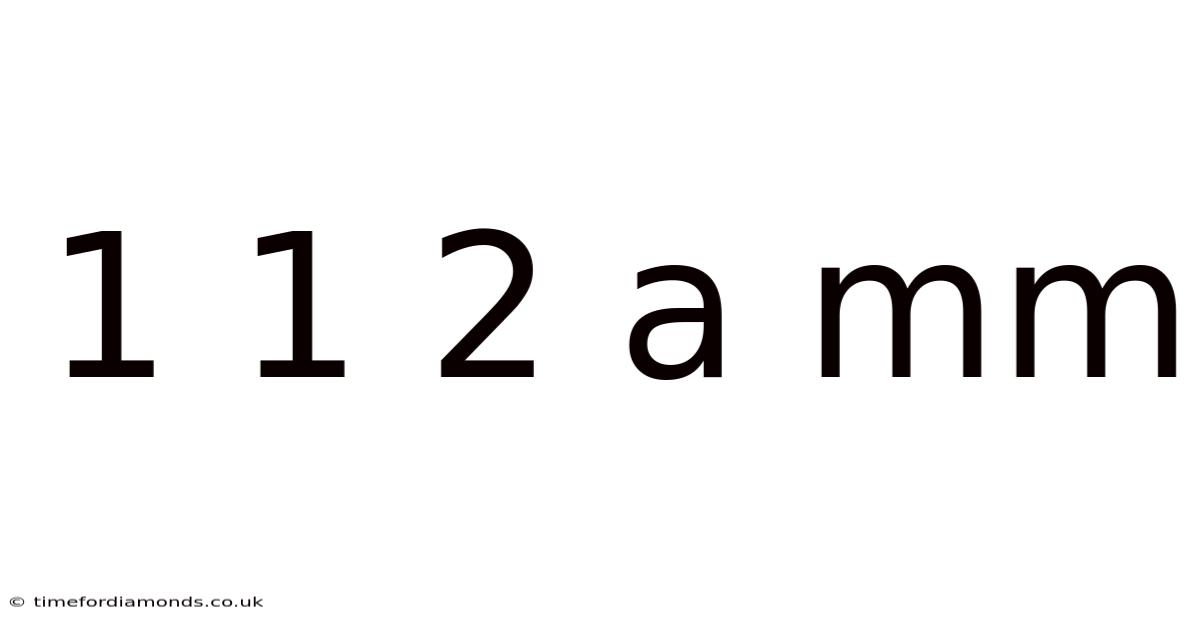
Decoding the Mystery: Understanding the Significance of "1 1 2 a mm"
The seemingly simple sequence "1 1 2 a mm" might initially appear cryptic, but upon closer examination, it reveals a fascinating connection to various fields, from mathematics and music to linguistics and even potential coded messaging. This article looks at the possible interpretations of this sequence, exploring its mathematical properties, musical representations, linguistic possibilities, and potential use in cryptography. Understanding its multifaceted nature requires a multidisciplinary approach, and we'll journey through each possibility to unravel its meaning.
Mathematical Interpretations of "1 1 2 a mm"
At first glance, "1 1 2 a mm" appears to be a simple sequence of numbers and letters. Still, a mathematical perspective opens up several avenues of exploration. We can analyze it in terms of:
Numerical Sequences and Patterns:
The initial part, "1 1 2," hints at a numerical sequence. Here's the thing — while it doesn't immediately fit known sequences like Fibonacci or arithmetic progressions, it could be the beginning of a more complex pattern. We could hypothesize that it represents a nascent sequence, perhaps requiring further terms to reveal a pattern. Further investigation might reveal if it adheres to a recursive formula or other mathematical relationship. It’s crucial to note that without additional data, any pattern identification remains speculative The details matter here..
Base Systems and Number Conversion:
Could "1 1 2" be representing a number in a different base system other than base-10 (decimal)? To give you an idea, if we were working in base 3, "1 1 2" would equate to 1*(3^2) + 1*(3^1) + 2*(3^0) = 9 + 3 + 2 = 14 in decimal. This highlights the importance of context. Without knowing the intended base system, the numerical part remains ambiguous Turns out it matters..
Not obvious, but once you see it — you'll see it everywhere Small thing, real impact..
Measurement and Units:
The "mm" at the end strongly suggests a unit of measurement – millimeters. Which means this introduces a spatial dimension to the sequence. The combination of numbers and the unit could potentially represent dimensions or coordinates. Here's one way to look at it: it could represent a point in a two-dimensional space, with "1 1" being the x and y coordinates, and "2" representing a third parameter such as depth or a specific characteristic. Again, context is crucial; without further information, the interpretation remains hypothetical Small thing, real impact. That alone is useful..
Musical Interpretations of "1 1 2 a mm"
The inclusion of letters alongside numbers opens up a connection to music theory and notation Simple, but easy to overlook..
Rhythmic Interpretation:
The numbers "1 1 2" could be interpreted as rhythmic values. In musical notation, numbers often represent note durations. Consider this: for example, in a simple time signature, "1 1 2" might represent a sequence of three notes: two quarter notes followed by a half note. The letters and "mm" would require further interpretation to incorporate them into a musical context No workaround needed..
Pitch Representation:
The letters "a" could represent a specific musical pitch, such as "A" on a musical scale. The context is again crucial; without knowing the octave or the musical key, its precise tonal position remains uncertain. The numbers could also potentially represent pitch intervals or other melodic elements. This interpretation necessitates a deeper understanding of musical notation and theory.
Linguistic and Cryptographic Interpretations of "1 1 2 a mm"
The combination of numbers and letters immediately brings to mind the possibility of a code or cipher It's one of those things that adds up..
Simple Substitution Ciphers:
The simplest approach would be to consider a substitution cipher, where each number and letter is replaced by another character according to a pre-determined key. This requires knowing the specific key or having additional coded messages to break the cipher through frequency analysis And that's really what it comes down to. And it works..
More Complex Ciphers:
The sequence might represent a fragment of a more complex cipher, such as a polyalphabetic cipher (like the Vigenère cipher) or a transposition cipher. Deciphering such ciphers often necessitates more extensive data and a deep understanding of cryptographic techniques.
Linguistic Context and Meaning:
It's also possible that "1 1 2 a mm" isn't a code but rather an abbreviation or an informal notation within a specific field or community. Without further context about its origin or the intended audience, it's impossible to ascertain its meaning through a strictly linguistic approach Simple, but easy to overlook..
Expanding the Scope: Exploring Potential Applications
While the direct interpretation of "1 1 2 a mm" remains somewhat ambiguous, exploring its potential applications broadens our understanding.
Measurement and Engineering:
As mentioned earlier, the "mm" suggests units of millimeters, a common unit in engineering and design. The sequence could represent specific measurements within a design specification, a blueprint, or a manufacturing process That's the part that actually makes a difference..
Data Coding and Tagging:
In data systems, short alphanumeric sequences like this could function as tags or identifiers, particularly in databases or software applications where brevity is prioritized.
Game Design and Programming:
In game development or programming, the sequence could be a part of an identifier, a code within a game engine, or a placeholder in a larger data structure.
Scientific Notation and Experiments:
In scientific experiments or data collection, the sequence could be a shortened notation for specific experimental parameters, trial numbers, or observed phenomena.
Frequently Asked Questions (FAQ)
Q: Is "1 1 2 a mm" a known mathematical sequence?
A: Currently, there's no established mathematical sequence matching "1 1 2 a mm." The initial numerical part doesn't directly align with known sequences, though it could potentially be a portion of a larger, more complex pattern.
Q: Could it be a code?
A: The possibility of a code is quite high. That said, deciphering it would require more information, possibly additional examples of the coded sequence or knowledge of the cipher system used.
Q: What about the "a"?
A: The "a" could represent a variety of things depending on the context, including a musical note, a letter in a substitution cipher, or a variable in a data structure.
Q: How can we decipher "1 1 2 a mm"?
A: Deciphering the sequence requires additional context. Knowing its origin, the method of encoding, and potentially more examples of encoded information would be crucial to decipher its meaning Worth keeping that in mind..
Conclusion: The Enigma of "1 1 2 a mm"
The seemingly simple sequence "1 1 2 a mm" proves surprisingly multifaceted. Which means its interpretation hinges heavily on context. While it doesn't currently align with known mathematical sequences or readily identifiable codes, its potential applications span various fields. Which means mathematical analysis, musical interpretation, and cryptographic approaches all offer different avenues for exploration. The bottom line: the true meaning of "1 1 2 a mm" remains elusive without additional information. Still, this exploration highlights the diverse ways seemingly simple sequences can hold rich potential meanings, urging us to consider context and explore multiple perspectives when faced with similar enigmatic combinations. The journey of decoding this sequence showcases the interdisciplinary nature of problem-solving and the power of analytical thinking. Perhaps, future discoveries will provide more clues to access its definitive meaning.
